Use this micrometer to nanometer converter to switch µm to nm instantly, with clear results, rounding options, and quick examples for lab, engineering, and school use.
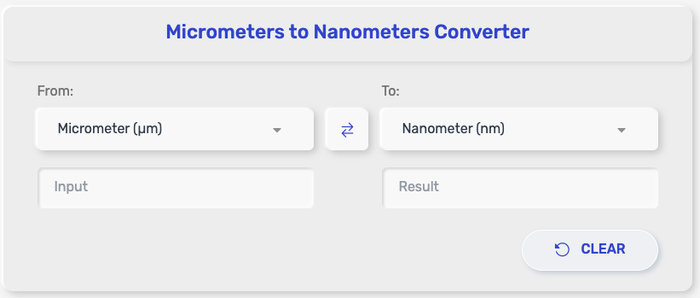
Convert micrometers to nanometers in seconds with this micrometer to nanometer converter. Enter a value in µm, pick rounding if needed, and get the nm result right away. Works for decimals, tiny measurements, and common scientific notation inputs.
How to Use the Micrometer to Nanometer Converter
To convert micrometers (µm) into nanometers (nm), you only need one number and a click. This micrometer to nanometer converter works with whole numbers, decimals, and very small measurements.
Enter your micrometer value (µm).
Choose the number format (standard or scientific notation), if available.
Set rounding or decimal places (optional).
Click Convert.
Copy the nanometer (nm) result.
That’s it—your result is the same length shown in nm, ready to paste into a lab note, datasheet, or homework.
What This Micrometer to Nanometer Converter Can Do
This micrometer to nanometer converter is built for quick, clean conversions you can trust in real work—whether you’re entering a simple whole number or a tiny decimal from a lab note.
Convert µm → nm for whole numbers and decimals
Accept very small values (for example, 0.002 µm)
Support scientific notation inputs (for example, 2.5×10⁻³ µm)
Show formatted output based on your settings (decimal places, commas, or scientific notation)
Offer handy actions like copy result and swap units (if your tool interface includes them)
Result Explanation
Your result is the exact same length you entered—just written in nanometers (nm) instead of micrometers (µm). Since a nanometer is smaller than a micrometer, the number usually becomes larger after conversion.
Here’s the simple relationship the converter uses:
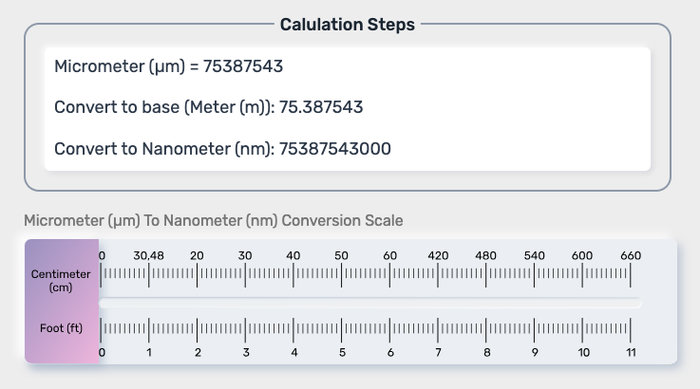
1 µm = 1,000 nm
So the tool calculates: nm = µm × 1,000
What the output is telling you
The nm value is your measurement expressed in a smaller unit.
Decimal places and rounding only change how the number is displayed, not the actual conversion.
Scientific notation may appear when the value is very small or when you choose a compact format.
Quick examples
1 µm → 1,000 nm
0.5 µm → 500 nm
0.002 µm → 2 nm
If you’re copying the result into a lab report or datasheet, match the rounding to the precision of your original measurement.
Common Use Cases
Micrometer to nanometer conversion shows up a lot when measurements bounce between “micro-scale” and “nano-scale” work. Here are common situations where converting µm → nm keeps units consistent and avoids mistakes:
Microscopy notes and images: Turning feature sizes labeled in µm into nm for nano-scale comparisons
Thin films and coatings: Converting layer thickness values to match specs listed in nm
Semiconductors and materials: Keeping the same unit across multiple sources (reports, datasheets, papers)
Surface roughness and polish specs: Many roughness values are reported in nm even when raw measurements start in µm
School and lab calculations: Quick checks to confirm you didn’t mix up prefixes during unit conversions
Micrometer to Nanometer Conversion Formula
The converter uses a single fixed relationship between the two units:
1 µm = 1,000 nm
So the calculation is:
nm = µm × 1,000
Quick mental math tip. If you just want to do it in your head, move the decimal three places to the right when going from µm to nm.
0.12 µm → 120 nm
2.5 µm → 2,500 nm
0.002 µm → 2 nm
Quick Micrometer (µm) to Nanometer (nm) Conversions
If you’re converting common values fast, here’s a quick cheat sheet. Rule of thumb: multiply micrometers by 1,000 to get nanometers.
Micrometers (µm)
Nanometers (nm)
0.01 µm
10 nm
0.05 µm
50 nm
0.1 µm
100 nm
0.2 µm
200 nm
0.25 µm
250 nm
0.5 µm
500 nm
1 µm
1,000 nm
2 µm
2,000 nm
5 µm
5,000 nm
10 µm
10,000 nm
25 µm
25,000 nm
50 µm
50,000 nm
100 µm
100,000 nm
250 µm
250,000 nm
500 µm
500,000 nm
1,000 µm
1,000,000 nm
A quick check: if your µm value has decimals, the nm result is usually a clean whole number (because it’s just × 1,000).
References
BIPM (Bureau International des Poids et Mesures) – The International System of Units (SI Brochure), 9th edition https://www.bipm.org/en/publications/si-brochure
NIST (National Institute of Standards and Technology) – Metric (SI) Prefixes https://www.nist.gov/pml/owm/metric-si-prefixes
NIST – Writing with SI (Metric System) Units https://www.nist.gov/pml/owm/writing-si-metric-system-units
NIST Special Publication 811 – Guide for the Use of the International System of Units (SI) https://physics.nist.gov/cuu/pdf/sp811.pdf
FAQ
How many nanometers are in 1 micrometer?
1 µm = 1,000 nm.
Why is the nm result bigger than the µm number I entered?
Nanometers are smaller than micrometers, so the same length uses more nm units.
Is the micrometer to nanometer conversion exact?
Yes. The relationship 1 µm = 1,000 nm is fixed, so the conversion is exact. Only rounding can change what you see on the screen.
Does rounding change the real value?
No—rounding only changes the displayed number. The converted value is still based on µm × 1,000.
Can I convert decimal values like 0.001 µm to nm?
Yes. For example, 0.001 µm → 1 nm.
Can I enter scientific notation (like 2.5×10⁻³ µm)?
If the tool supports it, yes. The converter will still multiply by 1,000 and show the result in nm.
What symbol should I use for micrometer: um or µm?
You’ll see both. µm is the standard symbol, while um is a common keyboard-friendly version.
What if my result shows scientific notation instead of a normal number?
That usually happens with very small values or when compact formatting is turned on. Switching to standard format or adjusting decimal places will show a regular number in many cases.
About us
Micrometertonanometer.com is a simple, fast, and reliable online tool designed to help users instantly convert micrometers to nanometers. Our goal is to make unit conversion easy and accessible for students, educators, engineers, researchers, and anyone who needs quick and accurate measurement conversions.
The tool is built to work directly in your browser with a clean one-page interface—no downloads, no registration, and no unnecessary complexity. Just enter a value in micrometers and receive the equivalent nanometer result instantly.
Micrometertonanometer.com is maintained by a small team passionate about creating practical online calculators and conversion tools that are easy to use and freely available to everyone.
We also appreciate the contributors, developers, and researchers who helped design, test, and improve this micrometer to nanometer conversion tool, ensuring that it remains accurate, efficient, and simple for everyday use.
Policy
We are committed to providing reliable, easy-to-use conversion tools while respecting user privacy and maintaining transparency.
Data Usage
Micrometertonanometer.com does not require account registration or personally identifiable information. Any values you enter for conversion are used only to generate instant results and are not stored or shared.
Accuracy Disclaimer
While this tool is built to provide accurate micrometer to nanometer conversions based on standard unit conversion principles, results are intended for informational purposes only. Users should verify important measurements independently when precision is critical.
Responsible Use
By using this tool, you agree to use it responsibly and understand that Micrometertonanometer.com is not liable for decisions made solely based on the converted results.
Policy Update
We may update this Policy from time to time to reflect improvements to the tool or changes in legal requirements. Any updates will be posted on this page to maintain transparency.